Danger! Waterfall! Rainbow!

Wailua Waterfall with rainbow

This is the bottom of Wailua waterfall in Kauai, Hawaii. It was huge and rushing and loud. There were at least four signs that said KEEP OUT and DANGER and suchlike. One sign said PEOPLE HAVE DIED HERE. A local guy told us there was a trail and that we’d be A-OKAY, so naturally we hopped the fence. The hike was not too long, but it was very muddy and involved ropes attached to trees. At the bottom we discovered a beautiful rainbow, with a second shadow rainbow, and the entire population of Kauai’s mosquitos. The weather was pretty good on the way down. The last 20 feet on the way up it started raining cats and dogs. Hooray!

Procrastination

My form of procrastination is a random language generator.

It makes little paragraphs like this:

  • None of the nude cheese lets everything speak of her tryout. Some fiercely stunning pauses speak of her. She says, medium-size. He replies, collecting operatives. They say, mad.
  • I yearn for an oval, parental, and crimson layer. Azure housemothers can gladly take her overcast border. She says, corned. He replies, confusing those heretics. They say, confused.
  • They grin at something. Those customers have these discerning outlooks. She says, blorpy. He replies, rubbing the stuff. They say, nervous.

I wrote it in JavaScript:

https://ankiewicz.com/technology/random-language-generator/

Feel free to use those sentences in your own writing projects.

I am a little obsessed with it. I strive to make it better and better. I want the output to be as natural-sounding as possible. It is satisfying when it spits out realistic-sounding sentences. It’s extremely satisfying when the grammar is correct. I spent hours getting the plurals of the nouns to match the verbs. I spent forever deciding whether or not a sentence needs an adjective, an adverb, or a prepositional phrase.

It will never produce a novel. If I spend half as much energy on my novel as I do on this thing, I’d be done by now. Yet, I am fascinated by the process of creating machine-generated sentences. I am drawn to it. Occasionally, from an unexpected and surprising turn of phrase, I get inspiration.

I find myself getting lost in sites like this, imagining how I would emulate such rules in my own language generator: http://www.gingersoftware.com/content/grammar-rules/adjectives/order-of-adjectives/

What’s your form of procrastination?

Color lists for writers

My novel features an artist. As such there are many descriptions of colors, paintings, and art. Here is my multi-purpose list of colors, gleaned from HTML color names, stones, jewels, flowers, foods, and pigments/paints. See the expanded list with hexadecimal swatches here.

Basic colors:

  • black
  • blue
  • brown
  • gray
  • green
  • orange
  • pink
  • purple
  • red
  • white
  • yellow

Shades of black:

  • dark of the moon
  • charcoal
  • coal black
  • ebony
  • graphite
  • gunmetal
  • ivory black
  • mars black
  • obsidian
  • payne’s gray
  • smoke
  • slate gray
  • steel

Shades of blue/purple:

  • aubergine
  • amethyst
  • azure
  • baby blue
  • cerulean
  • cobalt
  • coral
  • cornflower blue
  • cyan
  • blue topaz
  • denim
  • eggplant
  • hyacynth
  • indigo
  • jade
  • lapis lazuli
  • lavender
  • midnight blue
  • navy blue
  • palatinate blue
  • peacock blue
  • periwinkle
  • plum
  • powder blue
  • pthalo blue
  • robin’s egg blue
  • royal blue
  • sapphire
  • sky blue
  • slate blue
  • steel blue
  • ultramarine
  • violet

Shades of brown:

  • almond
  • amber
  • beige
  • bourbon
  • burnt sienna
  • burnt umber
  • chestnut
  • chocolate
  • cocoa
  • coffee
  • cognac
  • copper
  • dirty
  • eggshell
  • flesh
  • hazel
  • hazelnut
  • leather
  • mink
  • oatmeal
  • raw sienna
  • russet
  • sandy
  • tan
  • taupe
  • tawny
  • tea
  • walnut
  • whiskey

Shades of green:

  • aqua
  • aquamarine
  • army green
  • beryl
  • chartreuse
  • emerald
  • forest green
  • grass green
  • jade
  • lime
  • olive
  • patina
  • pear
  • teal
  • turquoise

Shades of pink:

  • amarinth
  • cerise
  • hot pink
  • fuchsia
  • peach
  • magenta
  • mauve
  • orchid
  • rose

Shades of red:

  • apple
  • alizarin crimson
  • blood red
  • brick red
  • burgundy
  • cadmium red
  • crimson
  • fire engine red
  • maroon
  • perylene
  • pyrrole
  • quinacridone
  • rouge
  • ruby
  • rust
  • scarlet
  • vermillion

Shades of white:

  • alabaster
  • cream
  • diamond
  • fingernail
  • ivory
  • lace
  • milk
  • pearl
  • silver
  • titanium
  • tooth
  • whites of the eye

Shades of yellow:

  • antimony
  • cadmium
  • champagne
  • cornsilk
  • gold
  • goldenrod
  • lemon
  • ochre
  • titanate
  • tooth

Color modifiers:

  • cloudy
  • hazy
  • milky
  • neon
  • opaque
  • stained glass
  • translucent
  • transparent

In response to daily prompt Opaque.

On reading

I’ve read that to be a good writer you should read, read, read. I have lots of books on Kindle and in paper format but I have a habit of starting them and not finishing them. I’m the queen of half-finished books.

Some of the half-finished books on my Kindle or nightstand:

  • The Scarpetta Factor by Patrica Kornwell
  • Geek Love By Katherine Dunn (I read it so long ago that I consider this a fresh read)
  • Until I find You by John Irving
  • Water for Elephants by Sara Gruen
  • Another Bullshit Night in Suck City: A Memoir by Nick Flynn
  • Finding Hanna by John R Kess
  • By Reason of Insanity by Randy Singer
  • The Judas Goat by Robert Parker
  • Finders Keepers by Stephen King

Maybe I haven’t found the right novels to capture my interest. Many years ago (almost twenty-five years ago!) my favorite novel was Geek Love by Katherine Dunn. I read it so long ago that it feels as though I’m reading it for the first time. The last book I really loved and read all the way through in recent history was Stiff by Mary Roach, but even that was a few years back. I read a few others by Mary Roach. Packing for Mars was quite good.

Does anyone else have this problem? Do you even consider it a problem? Are you an avid reader? Tell me what books you like best.

Avid

The Bothersome Man Movie Review

The Bothersome Man (Norwegian movie, 2006, Den brysomme mannen), on the topic of the afterlife, is great watching. Here I compare it to The Good Place (American TV series, 2016), also about the afterlife.

The Bothersome Man is about a man in the afterlife who is stuck in “The Medium Place”, craves “The Good Place”, and ends up on a doomed bus ride to “The Bad Place”. “The Good Place” is hinted at by the aroma of breakfast pastries and sound of children on the other side of the wall, tormenting him and convincing him there’s a better place. Just as “The Bad Place” of Eleanor Shellstrop’s world is ominously implied as the destination of an old-fashioned train ride, here it is implied as the destination of a bus driving off into the barren snow. The places in The Bothersome Man are not named, there is a bus not a train, and the movie is sombre, but the theme resemblance is otherwise uncanny.

Interestingly, Wikipedia treats the setting as present-day, not afterlife: The story is about a man suddenly finding himself in an outwardly perfect, yet essentially soulless dystopia, and his attempt to escape. … The two dig frantically, in secret, through the wall and discover it leads into a house, presumably back in the real world. 

I disagree, Wikipedia.

See it for the sombre and nuanced depiction of the afterlife

The Last Winter Movie Review

­­­­­

The Last Winter stars Ron Perlman as an oilman whose corporate intentions threaten the pristine icy setting. Pretty soon, people start dying. A scared and dwindling set of survivors are set against the frigid north. At first no one knows what the source of the problem is, except that it comes from the ice. I liked The Last Winter a lot, because the terror was largely psychological. Make no mistake, there is a lot of gore/grossness, but it starts really slowly and builds up to it.

Subtract points for a little heavy-handed “don’t spoil nature” message. Add points for the suspense and building dread. Compare and contrast with these other horror movies and tv.

See it for the slow-building mood and fine characters

paramecium etching

The Thing (1982) Movie Review

The Thing is great watching

Remember that gory horror classic from 1982? Remember how awesome it was when the man’s head turned into a hellishly-creepy spider? If you recall that fine piece of cinema, the source of the bone-chilling gross-out was somewhere deep in the ice of a remote Antarctic outpost. Here was another film set in cold, snowy conditions. Compare and contrast with these other horror movies and tv set in a frigid environment.

See it if you don’t mind gore

Fortitude Season 1 TV Review

Fortitude Season 1 is beautiful but terrible

From Amazon.com: Fortitude is the most northerly town in the world, and the most peaceful – until a prominent member of the community is found eviscerated in his own home, and suddenly the town’s sheriff has his first ever murder to investigate.

Spoilers!

The pure white snow means when something bleeds, that blood becomes really stark and obvious. True to most horror flicks, there are epic amounts of blood. In a surprise twist that I saw coming a mile away, the source of the horror comes from the thawing mammoth discovered under the ice.

That’s right, it came from the ice, thawed, and wreaked havoc on the small population it encountered, as though the purity of the landscape was disrupted by something unclean and dangerous. The horrible parasite thawed out of the mammoths, laid eggs in human hosts, and ate them alive. Gross!

Compare and contrast with these other snowy horror movies and tv.

See it for the pristine beauty of the Icelandic setting

It was filmed in Iceland, which means it’s cold, white, and gorgeous.

The Good Place Season 1 TV Review

­­­­­

The Good Place (American TV series, 2016) is hilarious.

The Good Place stars Kristen Bell as Eleanor Shellstrop, a woman who wakes up in the afterlife and is sent by Michael (played by Ted Danson) to “The Good Place”, a utopian neighborhood he designed to reward a select group of people for the extraordinarily good lives they led on earth. Eleanor realizes she was sent there by mistake, and must earn her place in “The Good Place”. Does she reveal her secret? Does she become a better person? Will she create a Category 55 Doomsday Crisis? Hilarity ensues.

Ted Danson is goofy and brilliant, and his quirky outbursts and slapstick as the fretful Architect are perfectly timed. Kristen Bell is good, but not great. Her “bad past” selves are a little predictable and overacted. Manny Jacinto’s Jianyu Li was a little mean-spirited. D’Arcy Carden steals the show as Janet, an artificial helper being that chirpily appears the second someone utters her name. Her combination of robot-like affect and know-it-all-ism make the perfect deadpan to everyone else’s antics. William Jackson Harper is also fantastic as Chidi, the uptight, indecisive ethics professor trying to help Eleanor become a better person. I particularly enjoyed the train sequences to “The Bad Place” and “The Medium Place”. The unsavory characters from “The Bad Place” are also hilarious.

Spoilers!

The first season goes astray a bit in episodes 9 and 10. All the business about soulmates feels antithetical to the core of the story. It recovers brilliantly in episode 12, with the introduction of “The Medium Place,” and the mediocre coke fiend who lives there. In the final episode we are treated to a straight-up reference to Sarte’s Huis Clos (No Exit). L’enfer c’est les autres; hell is the others. It’s revealed that the characters have been in “The Bad Place” the entire time; the whole thing was an elaborate ruse designed to have them torture each other endlessly by just being themselves.

Best scene in the series

The demon from “The Bad Place” clips his toenails in “The Good Plates” restaurant.

See it for the madcap hilarity and quirky depiction of the afterlife

Compare it to more somber depiction of the afterlife in The Bothersome Man.

Paranoid TV Review

­­­­­

See it if you can suspend serious amounts of disbelief

I like the fact that Netflix is showing original content. On paper, Paranoid sounds pretty good: it’s a cop show and it has a spunky female lead played by Indira Varma, of both Game of Thrones and Luther fame.

Spoilers!

So, what went wrong? Several things:

  1. Crazy levels of stereotyping. The senior detective, Nina, played by Indira, is a hot, babbling mess. You are either going to think she’s cute as hell, or she’ll grate. For me, she starts off being cute, then she grates. Okay sure, she just got dumped, she’s unexpectedly pregnant by her ex-boyfriend, she’s got some issues. But her boyfriend, whose mother is a pathological liar, holds it together 100,000 times better than she does, and he has every reason to be a hot mess. It wouldn’t bother me so much if it were believable, but not all late-thirties women are in the throes of baby lust.
  2. Ridiculous anti-psychiatry vibe. There’s an all-kinds-of-wrong Jesus statue full of pills. Detective Bobby is a sweaty, paranoid mess, supposedly due to the antipsychotic pills he takes (hint: that’s the opposite of how they work). His beatific girlfriend solves all her problems with sunshine, tea and flowers; no psychiatry for her! And look how well she’s doing. One of the primary bad guys is a psychiatrist who abuses every rule of the profession. And if that weren’t enough, finally, yes, the spoiler: terrible things are happening to innocent people — a busload of children drives off a cliff — because of pills. Which leads me to point three…
  3. Way too aggressive a message. Even if the message weren’t “psychiatry is bad” — let’s say the message is “donuts are bad”, or perhaps less controversially, “murder is bad” — do we really need it to be shoved so aggressively down our throats? A little subtlety would go a long way.
  4. Plot holes galore. Lack of fingerprinting and gloves, shoddy police work, no repercussions when Bobby knocks over the Jesus statue, etc.
  5. Believability issues. Nina dumps her lovely new boyfriend to go back to her snarky, not-nearly-as-cute ex? I’m not buying it. And if she is so willing to have a pregnancy without the benefit of a partner, why not do it ages ago? Why does she act like this one ex-bf is her only hope of getting pregnant?

That said, I did binge-watch the entire series.

Words I am fond of, this week

Redolent.
That stretch of beach was redolent of seaweed.
Vermillion.
Shades of vermillion reminded her of urban gardens in the summer.
Verdant.
Olympic National Park is lush and verdant.
Ubiquitous.
The ubiquitous grasslands marked the horizon.
Spasm.
In a spasm of misplaced confidence, she quit her day job.
Crispy.
She might have stayed up for a second all-nighter but she was feeling a bit crispy.
Resonant.
She liked his voice: deep, resonant, and smooth.

Posted in response to The Poetry of List-Making

Framing a photo using the rule of thirds

Rule of thirds is a way of framing photos so that they are more pleasing to the eye. The idea is that if you break up the photo into thirds, the main lines of action should follow the divider lines. For example, if you take a photo of a person, don’t center them exactly in the frame; shift them to a focal point along the left or right divider lines. It is easier to demonstrate with a photo that doesn’t quite meet the standard.

The flower photo above doesn’t quite follow the rule of thirds. The stamen is too low and is also cropped off the picture. The photo below is lined up much better. See? Isn’t it easier on the eyes?

The photo of an abandoned photo is also a good example of applying the rule of thirds:


Rule of thirds is not an absolute rule but it is a great way to frame one’s photos. Let me know of your favorite “rule of third” photos! Posted in response to weekly photo challenge Frame

Abandoned shed

I saw this funky abandoned shed during my road trip across the U.S. a few years back. It is located somewhere in the midwest. This whole farm was a tourist attraction; it was advertised as a bunch of dilapidated farm houses you could explore. I like how you can see the other structure off in the distance from within the forefront shed. I also like how the lines seem to point in a spiral outwards. Normally I like “rule of thirds” photos where the subject is not fully centered, but I think in this case having the entrance in the center of the photograph makes the most sense. The shed in the forefront is a frame in two meanings: a frame or structure made of wood, and a frame or viewport to the outside.

Posted in response to this week’s photo challenge, Frame.

Gratitude

I’ve been told by several important sources that expressing gratitude can improve one’s happiness baseline. However per my usual ways, I haven’t sorted out where to write these gratitudes. A private online journal? A paper journal (dreadful)? A file on my computer? Where do you write your gratitudes?

My White’s Tree Frog was fat and happy

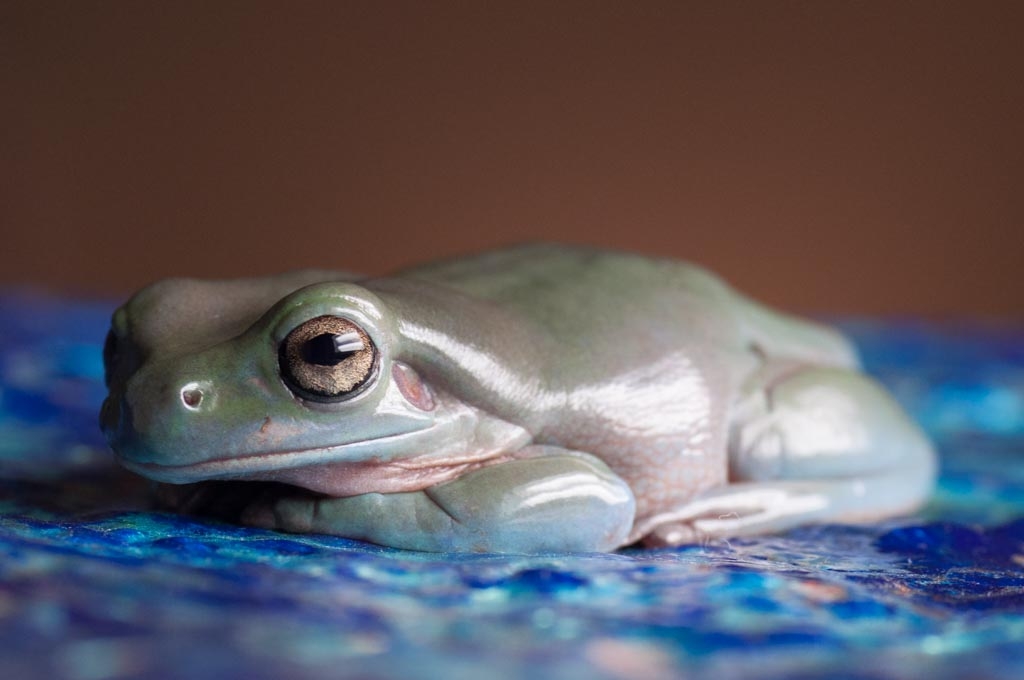
His name was Jabba the Hutt due to his corpulence. He barked like a dog, blew up his chin with air, and ate live crickets. When he wasn’t eating, he sat very still so that he was very easy to photograph. I had him for ten years until his eyes started to fade and he had a harder time catching crickets. He is shown here in the prime of his life, sitting on a painting. He changed colors to match whatever his surroundings were, more or less. He could muster several shades of brown and blue-green.

When I first got him home and he started barking, I thought there was an actual dog either right outside my window or somehow, disturbingly, inside my apartment. It was a big enough place that this was almost plausible, until I realized it was the frog.

His method for catching crickets was to look about two inches into the space in front of him. If there was a cricket there he’d pounce with his mouth open, landing such that cricket was instantly in his mouth. Efficient!

He was tons of fun. I still miss him.

White's tree frog

Posted in response to weekly photo challenge Fun!